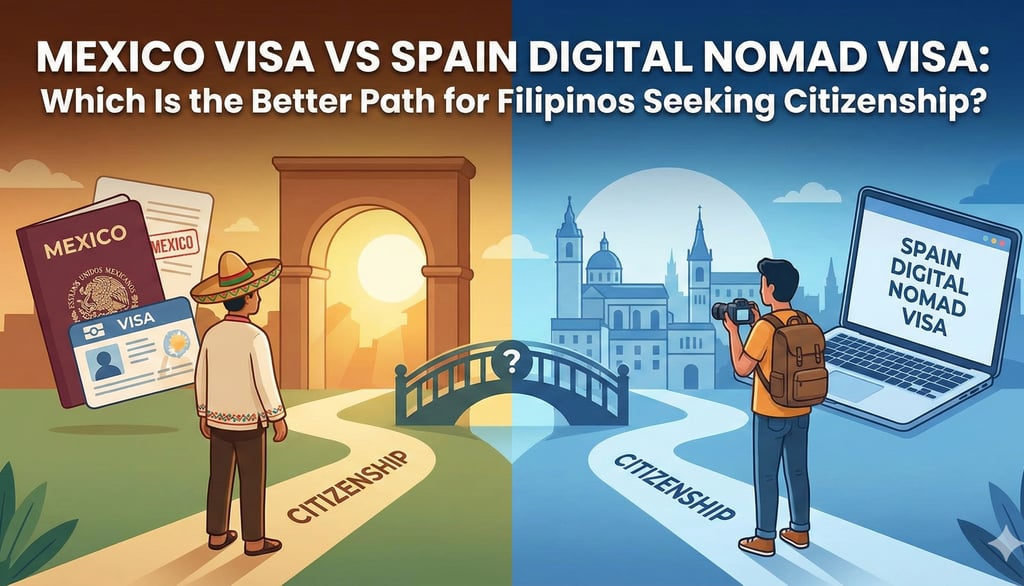
Mexico Visa vs Spain Digital Nomad Visa: Which Is the Better Path for Filipinos Seeking Citizenship?
For many Filipinos considering life abroad, choosing a country is not only about lifestyle or short-term affordability. It is about visa accessibility, long-term stability, safety, and very often — the possibility of citizenship and a stronger passport. Mexico and Spain are two countries frequently discussed among Filipino migrants and remote workers. Both are culturally warm, relatively affordable compared to other Western nations, and welcoming to foreigners. However, when examined closely through a Filipino lens, their visa systems, legal pathways, and long-term outcomes differ significantly.
SEVEN
12/21/20255 min read
Understanding Spain’s Digital Nomad Visa
Spain, on the other hand, offers a clearly defined and modern immigration route for remote workers: the Digital Nomad Visa (DNV).
Unlike Mexico, Spain’s DNV is based on what you do, not how much you have saved. It is designed for:
Remote employees working for companies outside Spain
Freelancers or self‑employed individuals with foreign clients
To qualify, applicants must prove a stable remote income that meets Spain’s minimum threshold. As of current standards, this is roughly €2,700–€2,800 per month for a single applicant. There is no requirement to show large savings.
Applicants must also submit standard documents such as a clean criminal record, proof of remote work, private health insurance valid in Spain, and apostilled and translated documents. While the paperwork is detailed, the requirements are transparent and predictable.
The Digital Nomad Visa is initially granted for one year when applied for outside Spain, with the possibility of renewal and conversion into a longer residence permit. After five years of continuous legal residence, holders may apply for permanent residency.
Understanding the Mexico Visa Path
Mexico does not have an official digital nomad visa. Instead, remote workers and financially independent foreigners usually apply under the Temporary Resident Visa (Residente Temporal).
This visa is not based on your profession or whether you work remotely. It is based almost entirely on financial solvency. Applicants must prove either a high and stable monthly income or substantial savings held over a long period.
In practice, Mexican consulates often require proof of roughly USD 4,000 or more in monthly income for the last several months, or USD 27,000–30,000 in savings maintained for at least a year. The exact figures vary by consulate, but the threshold is consistently high — especially for applicants coming from the Philippines.
Once approved, the Temporary Resident Visa allows you to live in Mexico for one year initially and can be renewed annually for up to four years. After completing four years as a temporary resident, you may apply for Permanent Residency, which allows indefinite stay.
Mexican citizenship, however, generally requires five years of legal residence. There are shorter paths only in very specific cases, such as marriage to a Mexican citizen. For most Filipinos, the standard five‑year rule applies, and naturalization commonly requires renouncing previous citizenship.
Mexico’s biggest advantage is its lower cost of living, particularly outside major tourist hubs. However, the financial entry barrier for the visa itself is high, and the citizenship timeline is relatively long.
Citizenship: A Key Legal Difference for Filipinos
One of the most significant distinctions between Mexico and Spain lies in nationality law.
Under Spanish civil law, citizens of former Spanish colonies, including the Philippines — may apply for Spanish citizenship after just two years of legal residence. This is a long-standing legal provision, not a discretionary benefit.
Equally important for Filipinos, Spain allows dual citizenship under this provision, meaning applicants are not required to renounce Philippine citizenship.
In contrast, Mexico’s standard citizenship timeline is around five years, with no special legal reduction for Filipinos.
Passport Power and Global Mobility
A Mexican passport offers visa-free or visa-on-arrival access to approximately 155–160 countries. It is considered a strong passport (usually ranked around Top 20) but does not grant freedom of movement within the European Union, and travel to the United States still requires a visa.
Strong access to:
Schengen Area
United Kingdom (ETA)
Japan
Most of Latin America
United States:
Visa required (B1/B2)
No EU freedom of movement
A Spanish passport consistently ranks among the strongest in the world (regularly ranked Top 2–4 strongest passports in the world), offering access to 190+ countries and full freedom of movement across the European Union. For Filipinos, this represents a major increase in global mobility.
Full EU citizenship
Live, work, study in 27 EU countries
Freedom of movement across the entire Schengen Area
Visa-free access to:
United States (ESTA)
Canada
United Kingdom (ETA)
Japan
South Korea
Australia (ETA)
Almost all of Latin America


Way of Life and Daily Living
Mexico and Spain both offer a slower pace of life compared to many highly industrialized countries, but the daily experience differs.
In Mexico, daily life is highly social and community-oriented. Systems can be flexible, but administrative processes often depend on local offices and personal follow-up. For some Filipinos, this adaptability feels familiar; for others, it may feel uncertain.
Spain offers a more structured environment. Public healthcare, transportation, and administrative systems follow established rules. While bureaucracy can be slow, it is generally predictable. Work-life balance is culturally valued, with strong family life and clear boundaries between work and personal time.
Cost of Living
Mexico is generally more affordable, particularly outside major metropolitan and tourist areas. Rent, food, and daily expenses are often significantly lower than in Spain.
Spain’s cost of living is higher, especially in cities like Madrid and Barcelona. However, smaller cities and regions such as Asturias offer a more moderate cost of living while maintaining access to strong public services, healthcare, and infrastructure.
For Filipinos, the difference often comes down to priorities: lower daily expenses versus long-term system stability and benefits.
Safety and Security
Safety conditions vary in both countries, but overall risk profiles differ.
In Mexico, safety can vary widely by city and neighborhood. While many areas are safe and popular with foreign residents, others require heightened awareness. Location choice plays a critical role in daily security.
Spain consistently ranks as one of the safer countries in Europe. Violent crime rates are low, and most safety concerns relate to petty theft rather than serious personal harm. This contributes to a strong sense of everyday security, especially for families and long-term residents.
Based on the 2025 Global Peace Index rankings: Spain is 21st, the Philippines 62nd, and Mexico 81st.
(https://worldpopulationreview.com/country-rankings/safest-countries-in-the-world)
Natural Disaster Considerations
Mexico is exposed to multiple natural hazards, including earthquakes, hurricanes, flooding, and volcanic activity, depending on the region. These risks are ongoing and region-specific. If you're a Filipino, that's nothing new.
Spain faces fewer natural disaster risks overall. While heatwaves, droughts, and occasional minor seismic activity occur, large-scale natural disasters are relatively uncommon. From a long-term settlement perspective, Spain is considered lower-risk environmentally.
Final Note
For Filipinos planning not just to live abroad, but to build a future with broader options, understanding the legal structure behind each visa is essential. Mexico and Spain both offer opportunities but they operate under very different systems, timelines, and long-term outcomes.
This comparison aims to provide clarity, based on law and documented requirements, so Filipinos can make informed decisions grounded in facts rather than assumptions. Everyone has their own preferences, and in the end, the choice is yours.
For Filipinos ready to explore Spain’s Digital Nomad Visa, check out our Spain Digital Nomad Visa Starter Kit. It provides step-by-step guidance, document checklists, income proof strategies, and realistic timelines based on lived experience.
Don’t forget to watch our YouTube channel MJ & Seven in Spain for personal insights, vlogs in Oviedo, and tips for Filipino digital nomads living in Spain.


LET'S CONNECT
Join us on our digital nomad journey.
© 2025 MJ & SEVEN | All rights reserved.
FOLLOW OUR JOURNEY